Imposter Syndrome, 65 Degrees, & Weaponized Curiosity
Imposter syndrome is often presented as a psychological issue womxn need to overcome.
As if the solution is simply confidence. Or mindset. Or “owning your expertise.”
But after decades in business—and after so many of you have so generously shared with us your work, your successes and your fears—we see something else: some ways that imposter syndrome is encouraged, built right into the system.
Sometimes—maybe even often—imposter syndrome isn’t a personal problem. It’s a problem with the system.
Here’s what that can look like:
😶🌫️ Simple Ideas Hidden Behind Jargon
Many industries turn straightforward ideas into complicated language. Sometimes the language is helpful shorthand. But often it functions as a signal of expertise. And a barrier to entry.
When you hear terms you don’t recognize, it’s easy to assume that the concept behind them must be complicated. Often it isn’t.
“Test a small batch before scaling” becomes a pilot program.
“Talk to customers about what they want” becomes qualitative research.
“Tell people about your product” becomes demand generation.
Don’t even get me started on the bullshit that is EBITDA.
Reframe
Instead of thinking “I don’t know what they’re talking about,” try asking yourself: “If I stripped the vocabulary away, what is the actual idea here?”
You’ll probably realize you’ve been doing versions of it all along. And explaining your work clearly and simply to a client or customer is a strength, not a weakness. Clarity signals mastery.
🌀 Over-Complicated Processes
Industries slowly accumulate layers—frameworks, tools, dashboards, certifications, best practices, standard protocols.
Some of these are useful, but over time, they can create the impression that a task requires an entirely new discipline to execute it well.
In reality, most professionals succeed by combining ✅ skills they already have, ✅ a few industry best practices, and ✅ iteration and learning.
The baker adding a new sweet to their menu doesn’t need to become a supply chain expert overnight. The consultant taking on a client in a new industry doesn’t need a new degree.
Often you need to learn a few key nuances, not an entirely new field. Sometimes the accumulated complexity even gets in the way of identifying the best approach or bringing new ideas to the table.
Reframe
Instead of thinking “I’m not trained in this,” ask yourself: What do I already know that applies here—and what are the two or three industry norms I should learn?
Most expertise grows from iteration, not certification.
⛓️💥 Industries In Need of Disruption
If you ever bought a mattress in the pre-Casper days, you probably wondered how something that seems so simple got so complicated. And because our tendency is to assume that the system is functioning rationally, you probably thought that—for some reason that you don’t know or understand—it needed to be that way.
Nope! And saying “I can make this simpler” was the seed of a company that was at one time valued at $1B.
Sometimes what you’re seeing clearly is an industry ready for disruption.
The entrepreneur who questions wholesale pricing norms.
The maker who simplifies production processes.
The consultant who cuts a 12-step framework down to three.
That instinct—the one that says there might be a simpler way—is often the start of innovation.
Reframe
Instead of thinking “I must be missing something,” try asking yourself: What if it’s the system—not me—that needs improvement?
Your outside perspective may also be your value.
😱 Catastrophizing from One Bad Result
Many of us internalize negative outcomes very quickly—a launch underperforms. A product doesn’t sell as expected. A client engagement doesn’t go well.
Suddenly the conclusion becomes “maybe I’m not good at this.”
But business outcomes are highly contextual. Maybe the audience was wrong. Maybe the pricing was off. Maybe the client wasn’t the right fit. Maybe the timing wasn’t ideal.
A single project contains dozens of variables. One outcome is rarely a verdict on your capability.
Reframe
Instead of thinking “I can’t do this,” try asking yourself: What exactly about that situation didn’t work—and what would I change next time?
Real expertise comes as much from our failures as our successes.
🕵️ Unwritten Rules
Many industries run on rules that no one explicitly teaches.
How buyers actually make decisions.
How proposals are really evaluated.
How retailers choose products.
How partnerships actually get formed.
People who grow up inside an industry often absorb this informally, even unconsciously. And it can make everyone else feel like they’re missing something.
But the truth is simple: No one ever told you the rules. And once you start asking questions, observing patterns, and talking to people in the ecosystem, those invisible systems become visible very quickly.
Reframe
Instead of thinking “Everyone else seems to know this,” try asking yourself: Who do I know or what technology could I use to explain how this really works?
Solving for this is why we started the Weak Ties/Strong Bonds Membership.
💁♀️ Confidence Masquerading as Competence
The business world rewards people who sound certain. That’s like 32% of Lauren’s success.
Statements like: “This is the strategy.” “The data clearly shows…” “The best practice is…” sound authoritative, even when they’re built on limited information.
Meanwhile, many highly capable people—especially womxn—communicate differently. They say: “Here’s what I’m seeing.” “This might be worth testing.” “There are a few ways to approach this.”
That’s not insecurity. That’s intellectual honesty. But in environments that reward certainty, it can create the illusion that others know more.
Reframe
Instead of assuming someone else must be more knowledgeable, try asking yourself: Are they actually more informed—or just more confident in how they say it?
The two are not the same.
Imposter syndrome is real. And some of the solutions come from within. But sometimes it’s just a very reasonable reaction to systems built—intentionally or not—to undermine your confidence.
And we know for sure that one of the solutions is surrounding yourself with a community that can demystify complexities, gutcheck ideas, and build up your confidence.
Need a little of that in your life? Get your tickets for our next dinner on April 15th.
🪢 Laura & Lauren
Things We Loved This Week
LaurA’s Things
🙅🏻♀️ I would do anything. Except that.
🗽 What country am I visiting from? The city of New York.
😍 This painter - Corgi and Dachshund owners will be especially obsessed.
Lauren’s Things
👑 FIRST OF ALL, her name is Ms. Jones.
🌆 This whole thread is a delight.
🍼 Weaponized curiosity. (FYI, tested it, the alcoholism approach does not work. Or I didn’t commit hard enough to the bit, but I’m p sure I did.)
To Tie Things Up…
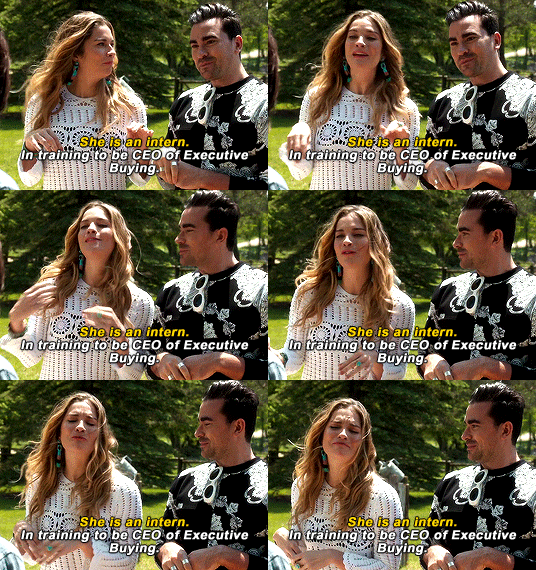
Forget mediocre white men, carry yourself with the confidence of Alexis Rose.